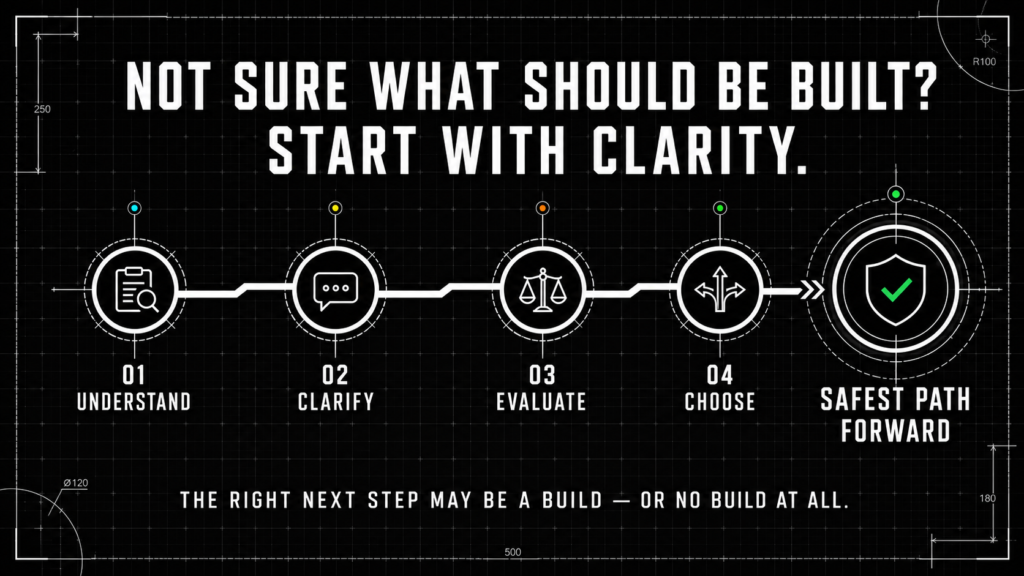
Learn why successful technology projects usually succeed or fail before development even begins, and how discovery helps businesses reduce risk, clarify priorities, and make better technology decisions.
Why Discovery Matters Before the Project Begins
Most business owners think a technology project starts when someone begins writing code. That makes sense. Software developers build software, right? In reality, the most important work often happens long before anyone opens a code editor.
Imagine deciding to build your dream house without knowing how many bedrooms you need, where the kitchen should go, or whether you even bought the right piece of land. Eventually, someone would probably build something. There is just a good chance it would not be the house you actually wanted. Technology projects work the same way.
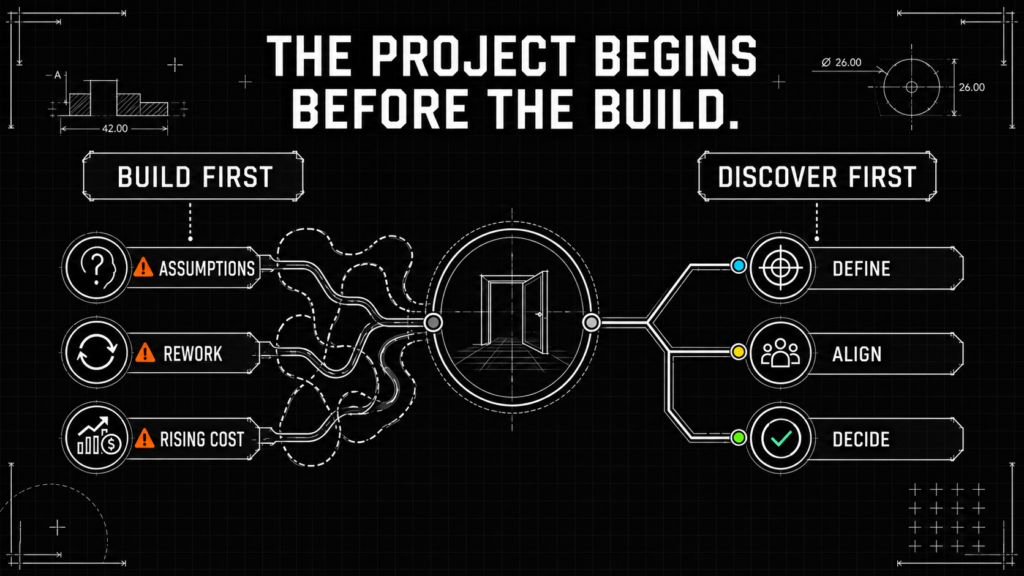
Most projects do not become expensive because developers suddenly forget how to build software. They become expensive because the business never fully defined the problem it was trying to solve. Expectations change halfway through the project. Different stakeholders have different ideas about what success looks like. Teams discover important workflows after development has already started instead of before.
That is why discovery matters.
Discovery is not about creating unnecessary meetings or producing documents that nobody reads. It is about making sure everyone understands the business, the goals, and the problem before time and money are invested in building a solution.
What Is Discovery?
Discovery is the process of understanding your business before deciding what needs to be built. It is the stage where questions are asked instead of assumptions being made. Rather than immediately discussing software features or development timelines, discovery focuses on understanding how the business operates today, where friction exists, what goals leadership is trying to accomplish, and what outcomes the project should support.
Think of discovery as the planning stage before a road trip. You could jump into the car and start driving, but without knowing your destination, the route, or whether everyone agrees on where they are going, there is a good chance you will waste time, money, and energy before realizing you took the wrong road. Discovery helps everyone agree on the destination before the journey begins. For growing businesses, that clarity is often more valuable than the technology itself.
Why Businesses Want to Skip Discovery
Discovery sounds slower than development. That is one reason businesses are often tempted to skip it. When a process feels broken, or a system causes daily frustration, the natural instinct is to fix it as quickly as possible. Leaders want progress. Employees want relief. Everyone wants to start building something that feels like a solution.
The challenge is that moving quickly without understanding the problem rarely saves time. It usually creates new problems instead.
A team requests custom software when a simple workflow improvement would have solved the issue. An automation gets built around a process that should have been redesigned first. Features get added because different departments have different expectations, only for everyone to realize halfway through the project that they were solving different problems. Suddenly the project costs more than expected, timelines shift, priorities change, and everyone wonders why something that sounded simple became so complicated. In many cases, technology was never the problem. The planning was.
What Actually Happens During Discovery?
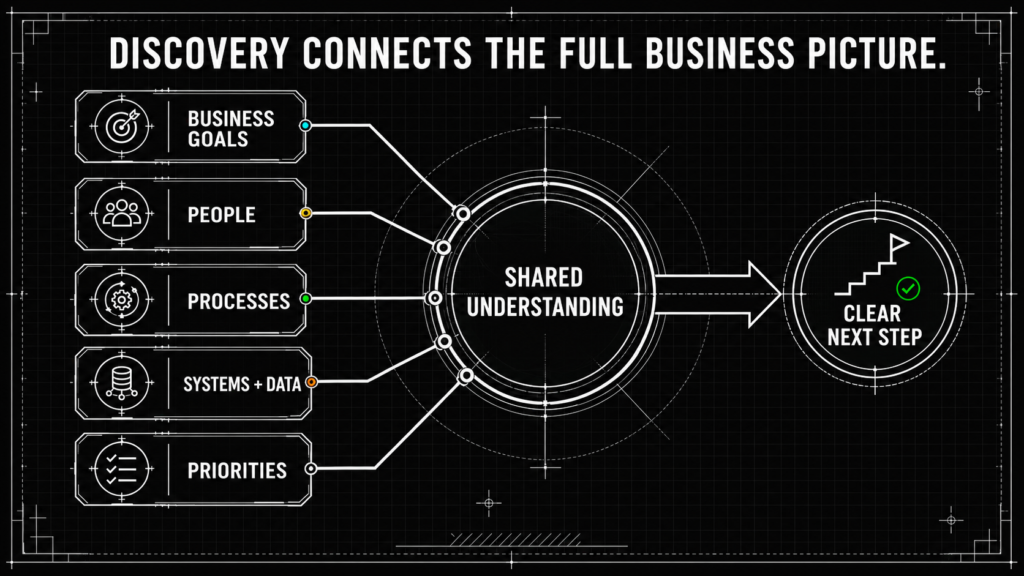
Discovery is really just a structured conversation about how your business works. The goal is to understand the current state before designing a future one. That usually begins with understanding the business itself. What are you trying to accomplish? What operational problems are slowing growth? Which goals matter most over the next year? How should success be measured once the project is complete?
From there, the conversation shifts toward the people doing the work every day. How does information move through the business? Where do employees spend unnecessary time? Which systems do they trust? Which systems do they avoid? Where do manual workarounds exist because the official process no longer fits reality?
Those discussions often uncover issues nobody originally planned to talk about. A reporting problem may actually be a data quality problem. A software request may actually be a process problem. A communication issue may actually be the result of disconnected systems. By the end of discovery, everyone has a much clearer understanding of what is actually happening inside the business and what needs to happen next.
Why Business Processes Matter Before Software
One of the biggest lessons businesses learn during discovery is that technology cannot fix an unclear process. If the workflow itself is inconsistent, adding more software simply allows the inconsistency to happen faster. Imagine trying to automate a recipe that nobody has written down. One employee adds ingredients in one order. Another skips a step. A third changes the measurements every time. Building software around that process does not create consistency. It simply makes the confusion happen more efficiently.
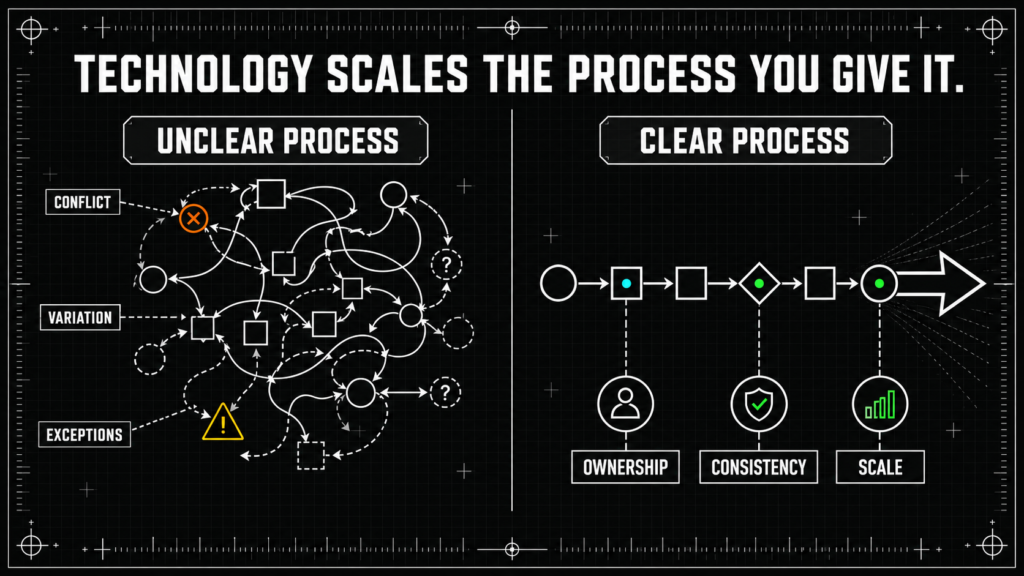
The same thing happens inside growing businesses. Customer onboarding works differently depending on who receives the customer. Sales follows one process while operations follows another. Approvals happen differently depending on who is available that day. Technology cannot create clarity where the business itself has not defined the process.
That is why understanding your Business Process is often one of the most important parts of discovery. Once the workflow is understood, technology becomes much easier to design around it.
Discovery Helps Clarify Requirements
Many business owners have a clear vision of what they want to improve. They just do not always know how to describe it in technical terms. That is completely normal. Requirements are simply clear descriptions of what a solution needs to accomplish. They are not technical specifications written for developers. They are business decisions written clearly enough that everyone involved understands the same objective.
Discovery helps transform ideas into requirements. Instead of saying, “We need better reporting,” discovery asks what information leadership actually needs to see. Instead of saying, “We need automation,” discovery asks which manual tasks are creating the biggest operational burden. Instead of saying, “We need custom software,” discovery asks whether custom software is actually the best solution or whether existing systems can be improved first. Those conversations reduce confusion because everyone starts working toward the same goal.
Discovery Helps You Choose the Right Solution
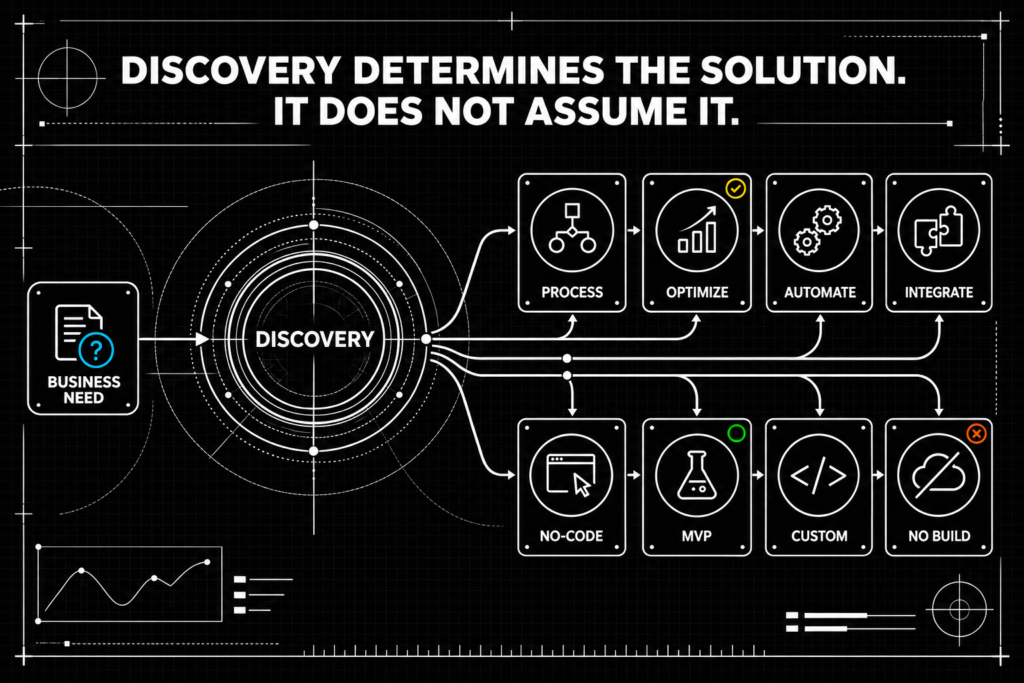
One of the biggest misconceptions about discovery is that it automatically leads to custom software. It does not. Sometimes discovery confirms that custom software is exactly what the business needs. Other times, it reveals that a no-code platform, an integration, a workflow automation, or a simple process improvement would solve the problem just as effectively for a fraction of the cost. That is one of the biggest benefits of slowing down before building. The business has an opportunity to evaluate multiple solutions instead of becoming attached to the first idea that came to mind. Good discovery does not start with a preferred technology. It starts with understanding the business well enough to choose the right approach.
Discovery Reduces Risk Before Development Begins
Every technology project involves some level of uncertainty. The goal of discovery is not to eliminate every unknown. The goal is to reduce unnecessary surprises before development begins. When expectations are clear, projects are easier to estimate. When workflows are documented, developers spend less time making assumptions. When stakeholders agree on priorities, fewer changes happen halfway through the project. When requirements are understood, businesses avoid paying to rebuild features that should have been planned differently from the beginning. Discovery creates confidence because everyone begins the project with the same understanding of what success looks like. That confidence usually leads to better communication, better decision-making, and better outcomes throughout the entire project.
Discovery Is Valuable Even If You Never Build Software
One of the most overlooked benefits of discovery is that it remains valuable even if the business decides not to move forward with development. That may sound surprising, but it happens more often than people think. Sometimes discovery reveals that the current systems only need cleanup. Sometimes it uncovers process improvements that remove most of the operational pain. Sometimes leadership realizes that a smaller project should happen first before tackling a larger initiative. And sometimes the business simply gains a much clearer understanding of how it operates today. That clarity has value on its own. Better visibility leads to better decisions, whether the final answer is custom software, automation, new integrations, or simply improving the way work already gets done.
Final Thoughts
Technology projects rarely become successful because somebody wrote excellent code. They become successful because the business understood the problem before asking someone to solve it. Discovery creates that understanding. It helps align business goals, workflows, systems, requirements, and expectations before development begins. It reduces uncertainty, improves communication, and helps businesses invest in solutions that actually support the way they operate.
Whether the outcome becomes Custom Software, an MVP, workflow automation, process improvement, or something much simpler, discovery provides the foundation for making confident technology decisions. If you know your business needs better systems or operational improvements but are unsure where to begin, Simplified can help clarify the process, requirements, priorities, and safest path forward before development starts. A strategy conversation is often the best place to start because the goal is not to build something as quickly as possible. The goal is to understand the business well enough to build the right thing or discover that you may not need to build anything at all.