Learn what a technology partner does, how they differ from freelancers and agencies, and how the right technology relationship can help your business grow with more clarity and confidence.
Technology Partners Simplified
A technology partner is someone who helps connect business goals, operational needs, systems, and technical execution.
That sounds simple enough, but it is actually very different from hiring someone to complete a specific technical task.
Most business owners do not struggle because they lack software. They struggle because technology decisions become harder as the business grows. New tools get added. Processes evolve. Teams become larger. Information starts living in multiple places. Before long, leaders are trying to make important decisions without having a clear picture of how everything fits together.
A technology partner helps bring clarity to that picture.
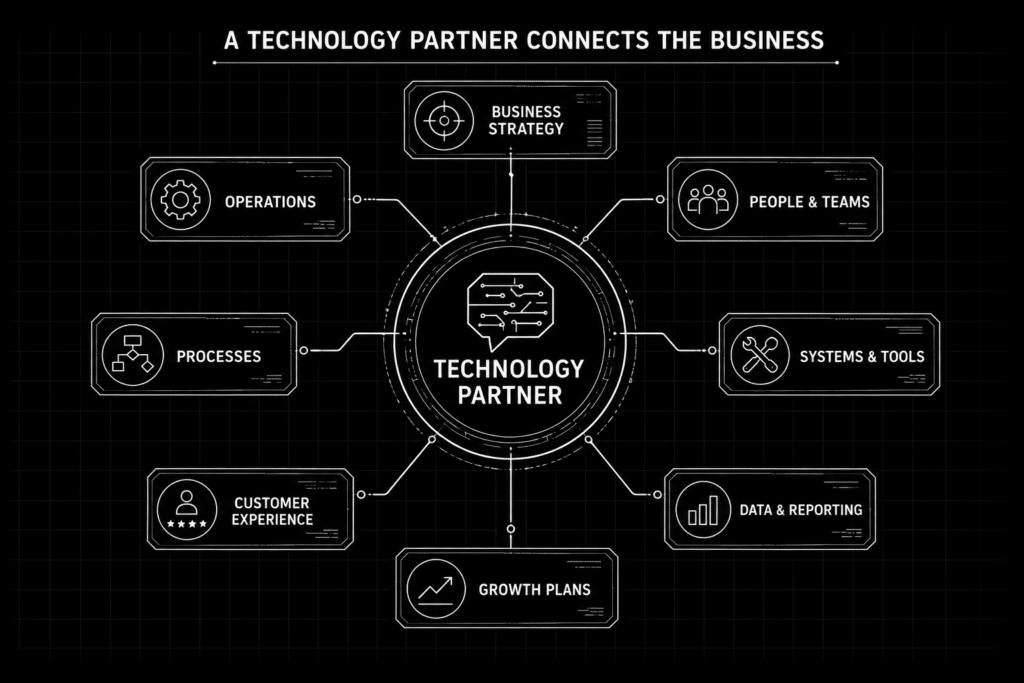
Rather than focusing only on what should be built, they focus on understanding how the business operates, where friction exists, and what improvements will create the greatest impact. They look at technology through a business lens first. The goal is not simply to deliver software, automate a process, or connect two systems. The goal is to help the business operate more effectively.
That often means conversations about workflows, reporting, operational bottlenecks, customer experience, team communication, and growth plans long before anyone discusses software requirements or development timelines.
For non-technical business owners, that relationship can be incredibly valuable because it removes the pressure of having to figure everything out alone. Instead of translating business challenges into technical solutions by yourself, you have a partner who can help bridge that gap and guide decisions along the way.
Technology Partner vs Freelancer
Freelancers can be an excellent solution when you have a clearly defined task and know exactly what needs to be done.
Maybe you need a website updated. Maybe you need a dashboard created, a workflow configured, or a specific integration built. In situations like those, a skilled freelancer can often deliver the work quickly and efficiently.
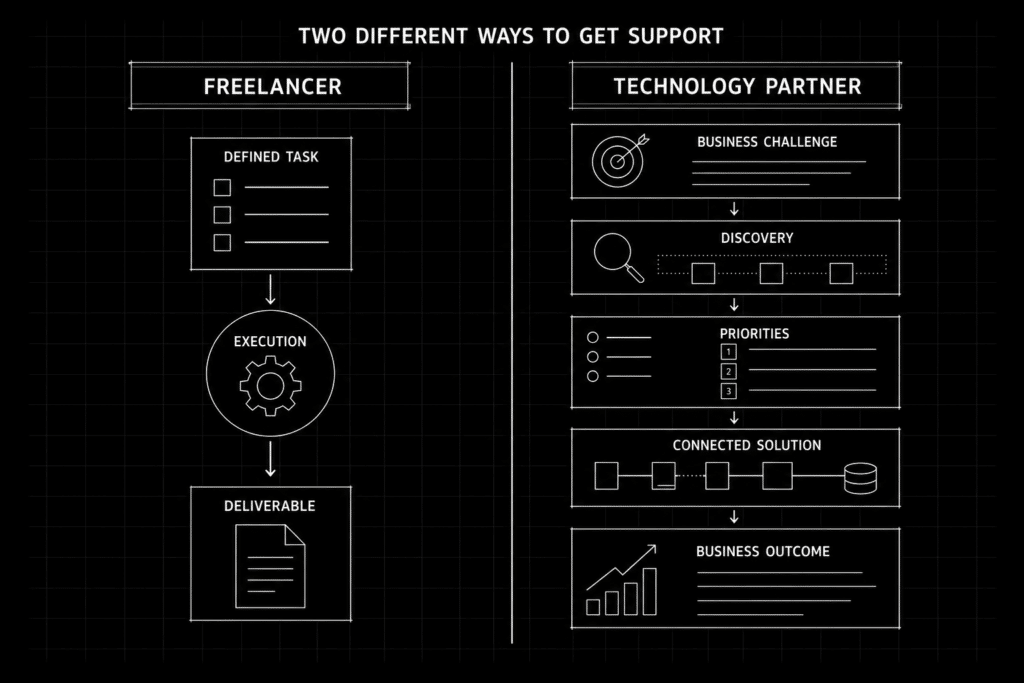
The relationship is usually straightforward. You define the task, the freelancer completes the task, and the project comes to an end.
There is absolutely nothing wrong with that model. In fact, for many businesses it is the most practical and cost-effective option when the scope of work is clear.
The difference is that freelancers are typically hired to execute a solution, not define one.
Their responsibility is to complete the work they were engaged to perform. They are usually not responsible for evaluating whether the project aligns with broader business goals, whether there is a better approach available, or whether the requested solution addresses the root cause of the problem.
A technology partner operates differently.
Instead of starting with the request itself, they often start with the business challenge behind the request. Rather than immediately discussing what should be built, they ask why it needs to be built in the first place. That shift in perspective often uncovers opportunities, inefficiencies, or process issues that would otherwise remain hidden.
For growing businesses, that difference can have a significant impact on the quality of technology decisions over time.
What a Good Technology Partner Actually Helps With
Many business owners assume technology partnerships are mostly about software development.
In reality, software is often only a small part of the conversation.
A strong technology partner helps businesses create clarity around how work gets done. They help leaders understand how information moves through the organization, where bottlenecks are slowing operations, and why certain processes create more frustration than they should.
Sometimes the biggest opportunity is not a new system at all. Sometimes it is simplifying a workflow, improving visibility into reporting, connecting existing tools more effectively, or identifying process issues that technology alone cannot solve.
Technology partners also help businesses prioritize. Growing companies often have more ideas than resources. There may be dozens of projects that sound useful, but not all of them deserve immediate attention. A good partner helps separate urgent problems from important problems and helps leadership focus on the initiatives that will create the most meaningful operational impact.
Perhaps most importantly, a technology partner helps reduce uncertainty.
Technology becomes much less intimidating when someone can translate technical complexity into practical business language. Instead of feeling overwhelmed by tools, platforms, integrations, and development options, business leaders gain a clearer understanding of what is happening, what matters most, and what should happen next.
Signs Your Business May Need a Technology Partner
Not every business needs a long-term technology partner.
Sometimes the right answer is a freelancer. Sometimes it is a software vendor. Sometimes it is an agency that can deliver a specific project and move on. There is nothing wrong with those options when the problem is clear, and the solution is already defined.
The challenge is that many growing businesses reach a point where the problem is not clear anymore.
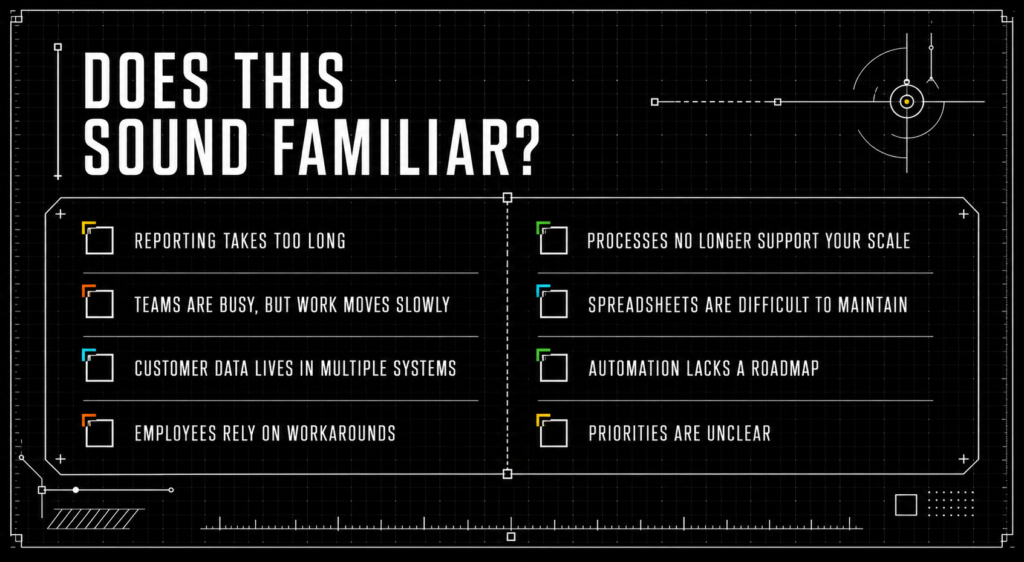
Leaders know something feels off, but they struggle to explain exactly what it is. Reporting takes too long. Teams seem busier than ever, yet work moves slower. Customer information lives in multiple places. Employees create workarounds because the official process feels harder than doing it manually. Everyone can feel the friction, but nobody can quite agree on where it is coming from.
That is often one of the strongest signs a business may benefit from a technology partner.
Another common sign is when growth starts exposing weaknesses in systems that used to work perfectly well. A process that worked for five employees may become frustrating with twenty-five. A spreadsheet that was manageable when updates happened once a week may become risky when multiple teams rely on it every day. The business has changed, but the systems supporting it have not evolved at the same pace.
Sometimes the signs are less operational and more strategic. Leadership wants to improve efficiency, automate repetitive work, or gain better visibility into performance, but there is no clear roadmap for how to get there. There are ideas, opportunities, and potential projects, but no clear prioritization.
In situations like these, the challenge is rarely a lack of technology. More often, it is a lack of clarity.
A technology partner helps create that clarity. They help identify what is actually causing friction, what should be improved first, and which initiatives will create the most meaningful impact for the business. Instead of reacting to symptoms one at a time, the business gains a clearer understanding of the bigger picture.
The Best Technology Partnerships Focus on Business Outcomes
One of the biggest misconceptions about technology projects is that success is measured by what gets built.
A new dashboard gets launched. Automation goes live. A new platform is implemented. A custom application gets developed.
Those milestones matter, but they are not usually the reason the project existed in the first place.
Business leaders rarely wake up thinking, “I hope we can launch a new workflow this quarter.” What they actually want is better visibility, faster reporting, fewer manual tasks, stronger customer experiences, or smoother operations. The technology is simply the vehicle that helps them get there.
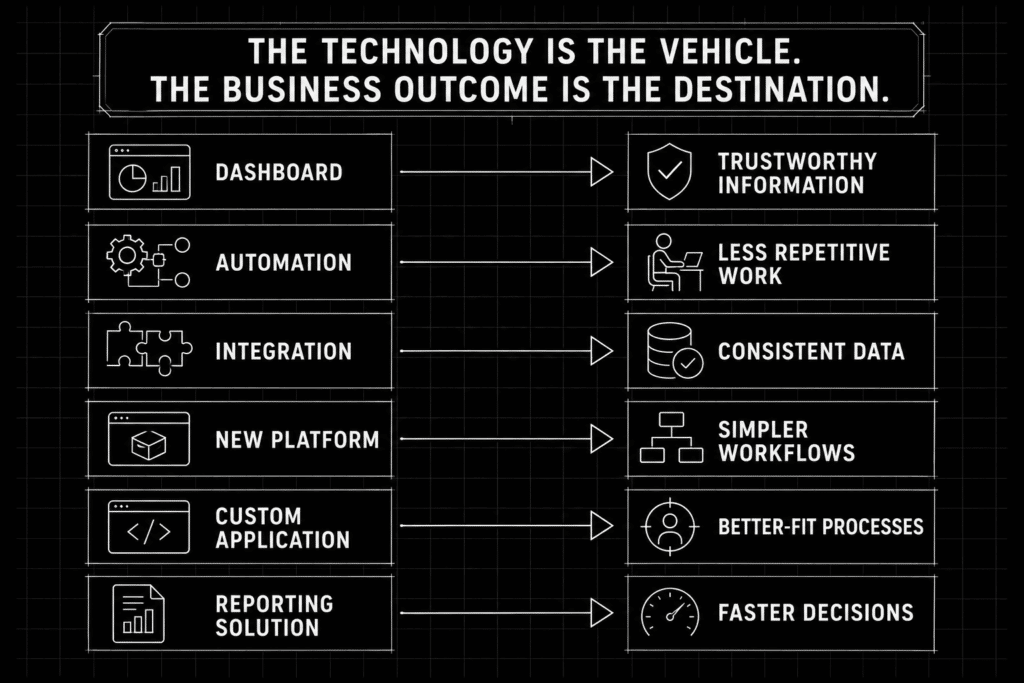
That is why the strongest technology partnerships focus on outcomes instead of deliverables.
The conversation stays centered on business goals. Are teams spending less time on repetitive work? Can leadership access information more easily? Are customer handoffs more consistent? Is reporting more trustworthy? Has decision-making become easier because the right information is available at the right time?
Those are the questions that matter.
A good technology partner understands that software, integrations, automations, and systems are not the finish line. They are tools that support larger business objectives. Building something impressive that nobody uses is not a success. Launching a simple solution that saves the team hours every week often is.
The best partnerships maintain that perspective throughout the relationship. Rather than chasing technology for its own sake, they continuously connect technical decisions back to the outcomes the business is trying to achieve.
What Happens Before the Technology Work Starts
Many business owners assume the first step in a technology project is building something.
A new application. A new integration. A new dashboard. A new automation.
In reality, the most important work often happens before any of that begins.
The first step is understanding the business itself.
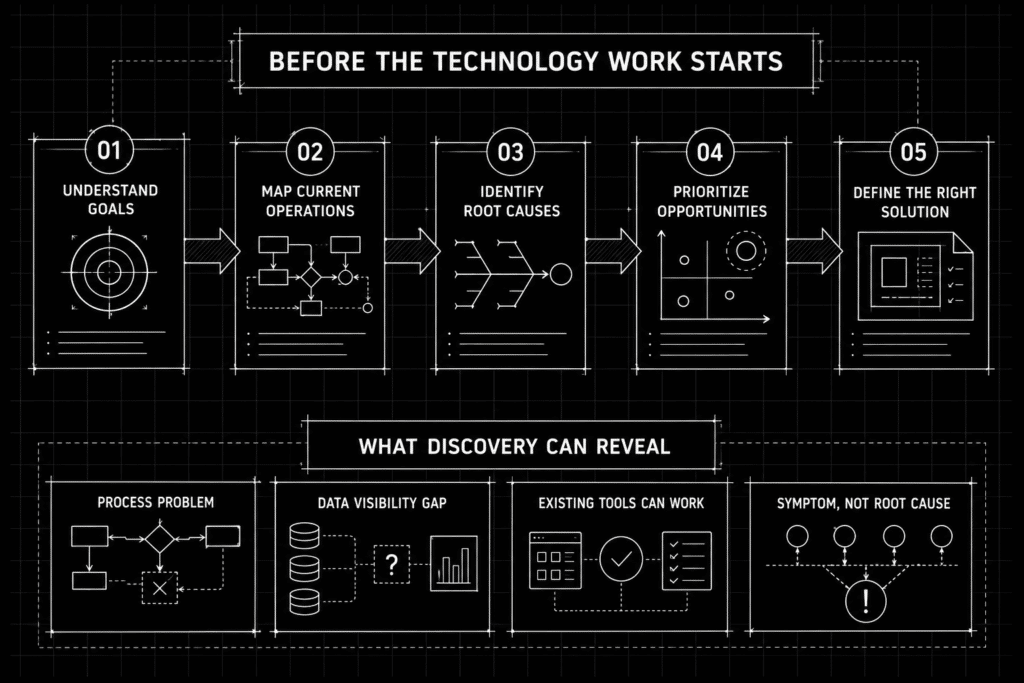
That means understanding how work currently happens, where information lives, how teams communicate, where bottlenecks appear, and what goals leadership is trying to achieve. Without that context, even technically successful projects can miss the mark because they solve the wrong problem.
Think about it this way. If a doctor prescribed treatment before understanding the symptoms, most people would be concerned. Technology projects are not much different. Before deciding on a solution, it helps to understand the situation clearly.
This is why discovery plays such an important role in successful technology initiatives.
Discovery is the process of understanding how the business operates today and identifying where opportunities for improvement exist. It helps uncover hidden process issues, conflicting priorities, unclear requirements, and operational challenges that may not be obvious at first glance.
In many cases, businesses discover that the original request was only part of the story. What initially looked like a software problem may actually be a process issue. What looked like a reporting problem may really be a data visibility issue. What looked like a need for a new system may simply require better use of the tools already in place.
The better the understanding at the beginning, the better the decisions that follow.
If you want to learn more about that process, read What Happens Before We Build: Why Discovery Matters and How to Prepare for a Technology Consultation.
Final Thoughts
A freelancer, developer, agency, vendor, and technology partner all serve different purposes.
The important thing is not deciding which option is universally better. The important thing is understanding which option best fits the challenges your business is facing right now.
If you have a clearly defined task and simply need someone to execute it, a freelancer may be exactly what you need. If you need software built, a developer may be the right fit. If you need a specific project delivered, an agency may be the most practical choice.
But growing businesses often reach a point where the challenge is no longer the individual project.
The challenge becomes understanding how systems, processes, reporting, people, and technology fit together. Leaders are no longer asking, “Who can build this?” They are asking, “What should we do next?”
That is where a technology partner can provide the greatest value.
A strong technology partner helps connect strategy, operations, systems, and execution. They help businesses move beyond isolated projects and make decisions that support long-term growth. They provide guidance when priorities are unclear, accountability when initiatives stall, and practical advice when technology starts feeling more complicated than it should.
Understanding how your business operations, systems, processes, and infrastructure work together is the first step toward creating a clearer operational and technical roadmap.
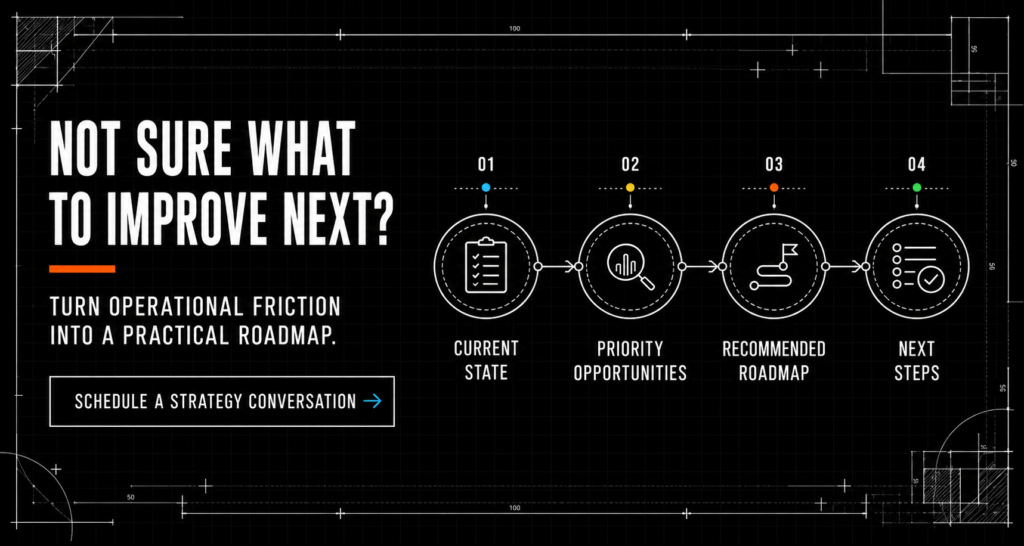
Simplified can help you create that roadmap with greater clarity, confidence, and direction. If your business needs help connecting systems, improving operations, planning technology initiatives, or evaluating long-term technical direction, schedule a strategy conversation. Together, we can identify where friction exists today and what should happen next.